AI Follow-Up Messages That Get Replies After Events

Why follow-ups fail (and what actually earns replies)
Meeting someone promising is exciting—until the post-event inbox hits. Most follow-ups fail for predictable reasons: they sound generic, they arrive too late, or they ask for too much too soon. If a message could be sent to anyone, it usually gets treated like it was.
Replies come from reducing uncertainty and friction. The strongest follow-ups include (1) a personal recall detail that proves you were present, (2) a clear purpose, (3) one simple ask, and (4) an easy way to respond. That “easy way” matters: a yes/no question, two time options, or a single link beats an open-ended request every time.
A simple capture system right after the event
The fastest way to sound human later is to capture context while it’s still fresh. Within 5–15 minutes of meeting someone (or right after a conversation ends), log a few fields in Notes, a lightweight CRM, or a spreadsheet:
- Where you met: event name, after-party, group dinner, online community.
- What they care about: goals, current project, constraint, timeline.
- What you offered (or they offered): intro, resource, feedback, idea.
- Next-step idea: a low-commitment step that fits the moment.
Then add two small upgrades that make follow-ups dramatically easier:
- Tag by intent: collaborator, client lead, referral partner, peer/community, mentor.
- Write one “memory hook” line: a specific detail (project name, shared pain point, mutual friend, tool you both use) you can paste into your opener later.
Before leaving the venue, set a follow-up window on your calendar: same day for warm leads, within 24 hours for most meaningful connections, and 48 hours max for casual introductions. Speed matters because context decays—especially for people meeting dozens of others in a single evening.
AI-assisted messages that still sound like you
AI can help you move faster, but the goal isn’t to outsource your voice—it’s to reduce blank-page time. Use AI to turn your notes into a draft, then edit so it reads like something you’d actually type.
A practical structure that works across channels:
- Personal opener: lead with the memory hook, not a compliment paragraph.
- Purpose: why you’re reaching out in one sentence.
- One next step: a single call-to-action (CTA): quick reply, calendar link, or resource share.
Keep the first outreach under ~120 words when possible. Save deeper context for the reply thread where it’s welcome and relevant. Also match tone to the relationship:
- Peer-to-peer: friendly, brief, and collaborative.
- Lead: helpful and clear, focused on their need.
- Mentor/senior contact: respectful, concise, and specific.
To avoid “over-polished” energy, use natural contractions, vary sentence length, and don’t be afraid of a sentence fragment if that matches your style. AI drafts are often too symmetrical; real humans aren’t.
Follow-up timing and channel choices
Creators and freelancers often win replies by offering something small first—an intro, a resource, a specific piece of feedback—without turning the message into a transaction. For more on networking fundamentals and professional messaging norms, see Harvard Business Review’s networking coverage and HubSpot’s follow-up best practices. If you’re using LinkedIn, it also helps to understand connection and messaging options via LinkedIn Help.
Suggested follow-up schedule by goal
| Goal | First message | Second touch | Final touch | Best channels |
|---|---|---|---|---|
| Potential client | Same day or next morning; reference their need and propose a 15-min call | 3–4 days later; add a quick win or mini-audit note | 7–10 days later; offer to reconnect later and leave one clear CTA | Email, LinkedIn |
| Collaboration partner | Within 24 hours; suggest one concrete collab idea | 5–7 days later; share an example or draft concept | 10–14 days later; close loop and invite them to reach out anytime | Instagram, Email, LinkedIn |
| Peer/community | Within 48 hours; thank them and share a resource | 1 week later; invite to a low-commitment touchpoint | 2–3 weeks later; light check-in tied to something relevant | LinkedIn, Instagram |
| Mentor/senior contact | Within 24 hours; gratitude + one specific takeaway + one question | 7 days later; brief update + request a short call if appropriate | 14 days later; thanks and future-friendly sign-off | Email, LinkedIn |
Message templates for common scenarios
Building a repeatable smart networking system
Digital guide: AI Your Follow-Up
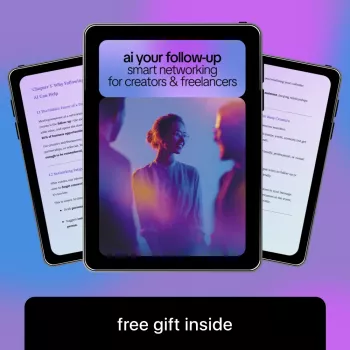
If networking volume is high and remembering details becomes the bottleneck, AI Your Follow-Up: Smart Networking for Creators & Freelancers lays out a practical structure for capturing context, drafting AI-assisted messages, and organizing ongoing touches—without sounding generic. It’s built for quick adoption and easy experimentation at $5.99.
Pair it with other quick digital reads if you like actionable, system-style guides: Smart Thrift: Unlocking Style Without Wasting Money and No-Nausea Ride: The Ultimate Digital Guide to Beating Motion Sickness on the Road.
FAQ
How soon should a follow-up be sent after a networking event?
Send it the same day or within 24 hours for strong leads, and within 48 hours for casual connections. Quick follow-ups keep the conversation context intact and make it easier for the other person to place you and respond.
How can AI help with follow-up messages without sounding automated?
Use AI to summarize your notes and produce a first draft, then add a memory hook and a single clear CTA. Edit the wording to match your natural tone and keep it brief—raw AI output often sounds too polished and generic.
What should be done if there’s no reply after the first message?
Send one value-added bump after about 3–7 days (a resource, a quick idea, or a specific question), then a polite close-the-loop message 7–14 days after that. After closing the loop, stop chasing unless you have a new, genuinely relevant reason to reach out.













Leave a comment